Showing posts with label Relationship. Show all posts

SHORT STORY: THE CHEATER


Author - Naval Langa

FOR SOME PEOPLE, their day starts with morning music, and for some with a fixed good smile from their spouses. For me, a day starts with one big thrust on my cabin door and the entry of a large-sized monkey-shaped man, my peon Bora.

“Ma’am, here is your coffee.”

Again a thrust on the door, and he goes out. On seeing him I always remember what Aristotle had written: ‘The man is a social animal’. I am sure he would have written the word animal in bold letters.

I have also read that animals do not smile.

I have no idea about other creations of God whether they smile or not. But I am ready to say on oath that Bora has never smiled, not even on his wedding day. This is only half of the details about him. Another half you would immediately get by just looking at his square face, uncombed hair, and a permanent bidi in his mouth

We have two different species of animals in our office. Another one is Bhima. He is from the world of sophistication. He is lighter than the light. You can measure his lightness right from his feet. Light slippers in feet, light colour pyjama and kurta, and finally the lightweight head. But whenever you look at him he would be smiling, no reasons needed.

“Would you like a biscuit with tea Ma’am?”

And it would fetch him a ten-rupee note. A packet of biscuits costs seven rupees. I take biscuits daily, my doctor has told me so for maintain a good level of sugar in my blood. I remember everything that my doctors told me. But I do not remember the day when Bhima had given me three Rupees back. After putting the packet on my table he would just stand at the door and do his all-time favourite act: smiling.

At home, I would talk as little as possible about my office. But whenever Vijay, my dear husband, refers to his staff, it would prompt me to stand up on a sofa and clear my throat. “Let… let me introduce my staff.”

I would copy the movements of my entire staff. One-by-one. Miming of the office ranges from slightly comic to heavily funny—comic when I talk about the personal secretary, Elena, and funny when I talk about the habits of my peons. The most terrible is my local manager’s character, Mr Prakash. He is a thin primitive ape in a suit, wearing coloured specs even in darkness.

On Vijay’s ‘once more’ I would copy all the functions of Mr Prakash’s eyeballs, which always keep touring around the regions of Elena’s table. There are several other versions of his introduction available from our staff. But the most authentic is like this. He has married twice. The first wife always kept his credit cards overdrawn, arranged big parties, and finally eloped with her ex-boyfriend, an owner of a chocolate factory. The second is wealthy, seven years older than him and she, the wealthy second wife, calls him ‘puppy’.

Vijay would keep thumping sofa sides with bursting pleasure and clap in between. “O my God. Please, Julia, have an interval. Please. Now I will recognise anyone of your colleagues at first sight.”

This is how my staff provides free of cost entertainment for us.

    *************

TODAY BHIMA WAS collecting his monthly loans. He borrows from all those who are addicted to giving him money. Borrowing is his time-bound habit, always starting from the twenty-fifth of every month. There are fifteen staff members in my office, including the ‘puppy’. But Bhima would get money only from four persons. And he is a man of confidence, too. He would borrow from me only after exhausting the other three sources. 

He knows that I would never say no. He would look at my purse and smile incessantly, and I would assume that the date must be twenty-seven or twenty-eight.

But today was a different story. He demanded a big amount from the three other lenders and had already collected more than Rupees two thousand. He was not smiling today. Strange.

“Sir, my mother is ill. I need five thousand.” He told everyone.

The day was to end and Bhima had not yet contacted me. I had kept the delivery ready for him. I knew certain facts about his mother, too. And at last, he came in and looked straight at my purse. He had confidence. He might have hoped, as big as Rupees three thousand in his eyes, too.

“Ma’am, my mother is ill. Please give me three thousand. I will repay after getting a loan from Provident Fund. Please, ma’am.”

“You just get out of my cabin.” I delivered all that I had kept ready inside of my skull. It was, perhaps, a big blow for Bhima and a wonder for the rest of my staff members. They had never seen me in an angry mood.

     ************

VIJAY IS A READER of the moods. He would have caught the filaments of distress on my face. On that evening, we were sitting on a good chair of a good restaurant in a very good surroundings.

It was on Vijay’s insistence: the dinner.

A waiter in a red coat, which they all put on even on hot summer days, first stood beside me, vertical as a new recruit in the army. With pole-straight limbs and non-stop smiling, he looked like a red chocolate bar melting from its top.

In restaurants, Vijay always followed a logical sequence. First, he would check the menu, searching for the articles that would not act as the rebels in our stomachs; and then he would dictate a foot-long order admiring the waiter’s dress, telling him to apply a greater portion of his energy for speedy execution of the order. 

The sequence followed that evening, too. The melting chocolate bar, the waiter, wrote down the foot-long order.

“Julia, I am to tell you one thing.”

“Don’t tell me that you have won the lottery.”

“No. I am serious.”

Then the words he spoke, the information he revealed, the circumstances he narrated for not telling me about the issue and his pleading for an unconditional apology for the matter he kept secret till the day: this everything went into my head and heart like fireballs.

I straightaway left the table, leaving everything as it was, and ran out of the restaurant. I thrust open the car door and sat inside, sobbing, almost crying, and repenting for believing that I was the happiest woman in the world and that my husband never kept anything secret from me. 

It was the greatest defeat for me. I felt as if the land under my feet had been snatched, the land on which I stood firm till the date. I was still unable to believe what he had said. But it was a fact. And the fact was a bombshell: before we met, Vijay was married. He had taken a divorce.

“Julia, I… I am…”

“Don’t touch me.”

The road up to home was dead silent. The night was sleepless for me. I did not care whether he was sleeping or awake. He was on the drawing-room sofa till morning.

     ***********

NEXT DAY: the coffee is on my table. I do not remember whether Bora has thrust the door or not. Bhima is absent. His Provident Fund loan application is on my table. I sign it immediately for sending it to our head office.

“I will be back within an hour,” I tell Elena who looks after my work in my absence.

I know where Bhima lives with his family.

I drive out of the city. A giant-sized ditch, a bucket for dumping the garbage is a dividing range between the main city and the area where Bhima and people like him live. 

There comes a polluted water pond. It is full of dirty water as if the whole city had vomited and the liquid is gathered therein. My car dribbles through the heaps of garbage, transported from the city, and then runs on a straight road that looks like a long swollen bruise, or a mark of a flog on the back of the land.

On seeing my car, Bhima comes running. He gets me sitting in a room where his wife is visible, sleeping on a cot.

“Bhima, you may not be remembering, you might not have seen me on that day, but I was the only person from our office to visit your home on the day your mother died. It was a rainy day and I sat among women.”

“You know ma’am…”

“It’s okay. Take these three thousand and don’t worry about paying it soon.”

“Ma’am, I lied because I needed money for my wife’s illness, I mean the delivery. Everyone would have laughed at me, as this is our fourth child. So I told everyone in the office that my mother was ill.” His eyes are tearful and so are mine.

He makes tea. He gives me biscuits and smiles, too.

Bhima was a small liar. He lied only for a small gain, borrowing money for a week. He is not a cheater. Some people cheat and cheat on a great scale. There are cheaters, who inflict lifelong wounds on others. 

 THE END

 [Image courtesy Julia Margaret Cameron,

Public domain, via Wikimedia Common]
William McGregor Paxton, Public domain, via Wikimedia Commons

The Transplant : The woman who paid her bill well

Author - Naval Langa

PEOPLE WERE UNABLE TO SWALLOW the idea. Nor my staff working under me could decode the thing. It was not the case they were unconcerned about Madame’s health. They loved Madame, our boss, too much; all of them were worried about her illness, too. 

Doctors had said that her kidneys were non-functioning; she lived on doses of regular dialysis. My assistant Kapila had vowed to go to the temple of Lord Shiva for the whole of the month, walking barefooted; Shariff, our peon had vowed to fast for one week. But no one understood my decision: my decision to donate one of my kidneys to Madame.

But I worried for Vijay, the man who had conjured up living with me. It is just one year before I had met him. But from the very first day, he is a non-erasable impression on my soul. Whenever I see him, I feel that I am not alone in this world. 

I felt I needed an explanation to him regarding why I was donating my one kidney to Madame. Coping with the weakness of my tongue, I decided to use pen and paper. I wrote about my past, everything about my life before I came to this city. 

Dear Vijay, 

If you are planning anything about your life keeping me in mind, this is what you should know. You know I have decided to donate a kidney to Madame. My life lives on two opposite sides of a border, ‘the border day’ of my life on which I had contemplated a simple act to accomplish. 

Do you know what was that contemplated act? It was suicide. I remember my past life as one would remember the moments passed after being crushed by a heavy truck and before turning unconscious. 

Our house was at the end of a closed street, perhaps the narrowest street of the town. It’s fading colour and falling plaster was a good excuse for the people not to look at it.  

The only prominent thing about it was my stepmother.  

My late mother, a music teacher, told me stories about stepmothers: stepmother is a symbol of misfortune; she beats the children; she bites them; she sucks their blood, too. And finally, the children either die or run away from homes. My stepmother followed the story-lines word-by-word. 

My father was weak before her young skin and high voltage voice. She came to rule my house when I was ten years old; she started to hate me when I was ten years old. 

However, she had given me an option, the option to choose between home and footpath. I chose home. She showed me how the pink cheeks of a tender girl could be turned into crimson red by pinching, and then dark red by blind slapping. She did it regularly: she did it extensively. 

Do you think I’m reading my prison record or writing an autobiography? Then let the next decade be axed: the years of no change in the climate. Winter: three hundred sixty-five days’ winter. But before seven winters, the season took an unpredicted turn.

Firoz: it was his name.  

Our neighbours talked that we were in love. My hopes were on the Mount Everest while counting midnight stars on the bank of the lake near to our city. Firoz talked about our marriage. The river of joy was flowing over my reason. The glittering of the city lights from a distance obliterated presence of all the guiding stars in the sky. Nature of the loneliness of the lake and the pleasure-heated bodies did their job. 

After a week he went to Japan on his business tour. ‘I will return within one month,’ he told me so. I was up in the sky, dreaming about the costly clothes and golden ornaments like Firoz’s mother wore. I was happy, as my one, at least one, the relationship was going to be successful. Happiness has its own power. I forgot my mother’s death; I forgot what I had suffered at the hands of my stepmother. A ray of hope had cracked the age-old crust of sorrow. Those were the days I regarded myself as the happiest woman on earth. My nights became fearless; days started assuming meaning. 

But the tower of rapture took no time to crumble. 

I found I was pregnant. 

The dark night at the lake had put its signature on my body. The signature was growing within me. It shook me at every inch. Fear arrested me at once. My town was a small place, and premarital sex an unforgivable offence. 

I called Firoz, in Japan. He was not so responsive as expected. His tone of talking was a deadly blow. Each word he spoke sharpened my fright. One month passed over my stiffened mind. I had lost communication with him. 

The weight under my belly was increasing day-by-day. One thing was certain: my God-fearing, society-fearing, wife-fearing, the father would not help me. I decided to meet Firoz’s parents. I went. There Firoz’s sister, keeping suspicious eyes wide open, informed me that her parents had gone to Japan—for attending Firoz’s marriage. 

Her words ran over my body like an army of biting mice. 

The arranged marriage had been solemnised before a week. Firoz had married a girl, a daughter of his mother’s friend who was a millionaire in Tokyo. Firoz or his father had a little say before his mother. Perhaps they, all the three, preferred money above all other things. Firoze’s parents were to return soon, but the newlywed couple was to settle in Japan. Permanently. 

The blow was fatal. Land under my feet was robbed: dreams crushed to the dust. I had known the ruthless reality. I was enticed; I was cheated. I had failed at my last hope. I ran to the lake, up to a black stone point. It was a point where women like me ran madly, stood on the highest stone, and then jumped in the lake, not to be seen alive again. I stood on the stone. I cried as loud and as long as I could. 

I was there not for leaping out of existence. Strangely, I did not dislike the thing that was growing within me: the child. Perhaps it was the only belonging I could define as ‘my own’.  

I decided to save what was exclusively mine.  

It was one and only possible order to rescue my shattered life. My thoughts, my feelings, my expectations from my life melted into one thing: the foetus, the unborn. My desperate eyes figured out a hope-scene: there would be a plant shooting out of me; it would become a big tree, and it would be my shelter. I wished; I longed for, and I preferred to have the baby. 

      *******

I CHOSE TO LEAVE the home, the city, the air, and run to quite a new land. No one would miss me: that was clear. And for the belongings, apart from my own body, I had one asset—a golden bracelet that my maternal uncle had gifted me on my twentieth birthday. I sold it. 

I left a chit for my father. ‘I am leaving home, not to return.’ 

The path was undefined. I reached the station. At the ticket window, I failed to decide the name of my destination. I bought a ticket for the last station. 

The whole world was at a standstill until the train had run for more than a day. I was sailing in an ocean that had no other bank. When it stopped, I came down on the platform. I wanted some food, not for me, but for the life that was developing under my belly. 

The heat was at its peak. Debilitated from head to feet, I was at zero points of strength. It knocked me down on the steps. I might have rolled on the steps, remained buried under stampede, or been crushed with a wall. I had no memory of what had happened. 

********

WHEN THE SENSES regained, what I saw was not part of a bad dream. It was hard reality, harder than I could imagine. I had no luggage, no money. No address. Nothing. My sole companion was the pain. 

I was in a solitary room of a maternity ward, on a bed clustered by nurses. The fall had spared me, but not the innocent being. The unborn that was going to be a plant had gone; the seed that was to be a big tree had been rooted out. The shelter I envisioned had fallen down. 

It was an abortion. The wound was still leaking blood. Doctors rushed. Nurses hovered. They were trying to save me. I had no reason to remain alive. A policewoman in starched uniform stood beside my bed. Writing something. I knew what it meant. Mine was a complicated case. 

When left alone, I passed an hour or so, looking at a ceiling fan. The zone of darkness was condensing. I saw my mother lying on the floor. People were tying strings over her body. My stepmother, sitting on my mother’s chest, was beating me with a stick—on my legs, on my thighs, on my knees. I wanted to scream. 

The fan was still moving. 

A feeling of total loss had wrapped up my being; my body reduced to a bundle of bones, skin, and pain. I had all types of pain, which could be on earth.  

I wanted love from my family; my stepmother stalled it. 

I wanted a job and to live independently; I failed to get it. 

I wished to be loved; I failed dangerously. 

The man of my dream had disappeared and married a rich girl. 

I wanted to have an illegitimate child. It was thrown out of me. 

Failing at every genre of human relationships, I was at the end of my life journey.

A deadly flash in my mind… I had no reason to prolong the life that was reduced to a nought. The room was closed in every respect, and the air was conducive for a death wish. Obeying the air, I tied my long dupatta around my neck and thought about how much time it would take to stand upon the cot, tie another end with the ceiling fan, and then jump down the cot. A copybook suicide, a dependable spade to rout out the self. 

Before I started executing the idea of routing the self out, a strip of sunrays lighted the expanse before my eyes. Someone entered in and get the closed window opened.  

I saw a face, the face that had an outline of a full moon. 

Her hand went on my head. It was a touch; it was a motherly touch. 

She stood beside me for some moments, caressing my head, instructing something to hospital staff in a few words—soft words. The voice was sweet, sweet like the bells ringing in temples. 

She was Madame. Madame Lataji.

 **********

 AFTER TWO HOURS, I was transported to another side of the river, into the big house owned by Madame. 

It was the last day of my life: it was the first day of my life.

Vijay, Madame rescued me from my certain death. She gave me a job. My life belongs to her. Donating a kidney is nothing for me when her life is concerned.

 I am still yours, but with one kidney missing,

 Seema.

 ****** 

TODAY, BOTH THE OPERATIONS are over. Both the patients are out of danger. But Mr Vijay, the man who waits for me on Sunday mornings in his disordered bachelor house, is sitting by the side of my bed, fondling my head. His eyes have the weight of a sleepless night. 

“Seema, I’ve got one month’s leave sanctioned. I think we need each other’s constant presence.” 

There sings a cuckoo, on a distant tree. 


END
[Image courtesy William Fettes Douglas, Public domain, via Wikimedia Commons]

FEAR : THE ENEMY OF LOVE


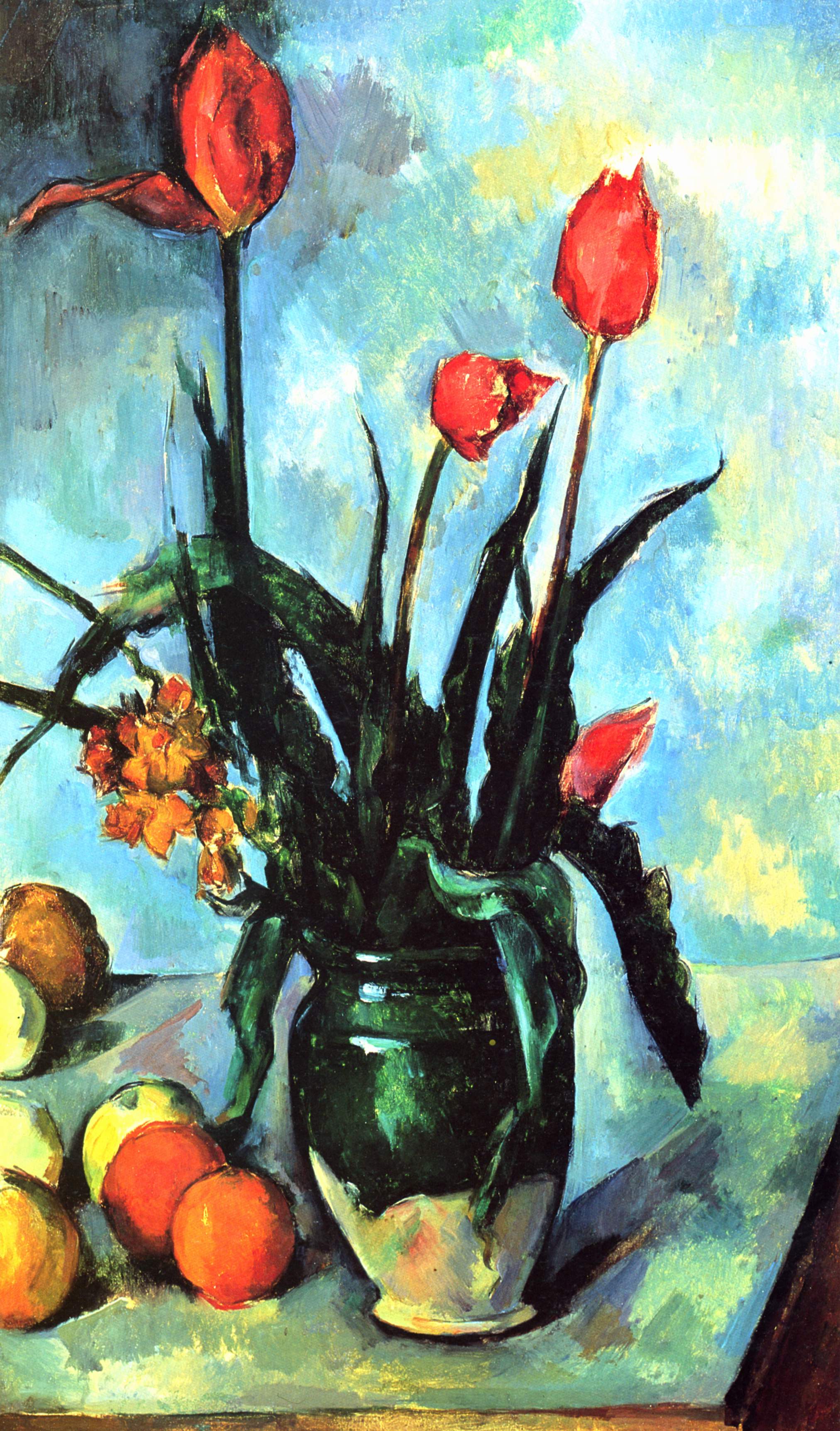
Paul Cézanne, Public domain,
 via Wikimedia Commons
Author: Naval Langa

THE CLOCK HAS no time to rest. But my time is frozen. Sun might have warmed Earth outside the hospital room; the moon might have cooled people’s bodies worn by fatigue, but I have lost feeling for such transients.  

For me, the clock has not resumed its importance yet. Ajay lays on the bed: attacked by the hooligans—three stabs in his belly. The doctors have struggled for the whole night with their surgical instruments.

Outside the hospital, there was a crowd. Ajay's staff. Suddenly the crowd shifted its attention. All eyes were on a woman: the woman who ran in with visible madness. She cut the serpentine line of men and women queued up to donate blood. People immediately spared way for her: the woman who seemed to have forgotten to walk, to breathe, and to mend her clothes. 

Her total stock of bones was possessed by uncontrollable trembling. Eyes: red, swollen, and tearless as stone. Staff nurses ran at the lady. They drove her and her protruding pain inside. But the lady did not stop; she ran blindly and struck her head with the closed door, the operation theatre door. 

“Open it…” She screamed. Fanatically. 

Her body collapsed on the floor. People seemed to know her. However, they did not know how the trembling figure was attached to the patient. But I knew. I knew her; I was sure about her painful identity: she could not be other than the library ma’am—Ajay’s ex-lover, the woman with whom Ajay had desired to pass his life. 

People get her pacified on a chair. Her face emitted a fact that how a worried lover could cry constantly without making a single piece of noise. 

I had not expected the figure that was sketched in Ajay’s diary, the figure that was written in the letter, to come before my eyes so painfully in flesh and blood--Charu, it’s her name, has chosen the path of social service and has distanced herself from worldly subjects.

There was only one other notable incidence since that day: when Ajay regained senses and kissed my palm, it was the moment I regained faith. It was the moment I lost all the courage I had accumulated and cried like a small girl who had lost and found her life. 

Thereafter, a few teacups, a couple of simple dresses, a small comb, and some pieces of bread with tea: these are the articles I have touched for my own purposes.

I have lost the past, distant or near; I have only the present, a sleepless present. The event manager in me has lost all the events and purposes, which arise in the outside world. My beloved is hit at life; he needs someone besides him; I am here, twenty-four hours, sixty minutes.

It strikes midnight, the seventh midnight. Late December has squeezed out every drop of noise from the air. The night does not carry the weight of any activity. It means all the gardens are mute at every leaf; the city is calm at every street. I put off the table lamp; and keep aside a partly read book.  

I feel like a tired seal. My limbs ache in between but never complain. The limbs have, perhaps, stopped sending signals of pain to my brain. Seven nights, each one longer than any other, …and eyelids feel the weight.

Midnight
Anders Zorn, Public domain, via Wikimedia Commons
It is raining… I am on a bank… a river, flooding out of banks. Am I standing on sand or a rock? I am not sure. And there I see a woman, surfing on the water waves, trying to cross the river... 

She is Charu, the library ma’am.

A quiver passes through my belly. My fear tells me: that one day there will be a bridge, a new bridge, connecting both banks. Or from the other side of the river, Charu with the oars of renewed passions would sail across the floating river. She would come with a yellow flower in her hair… and snatch Ajay away… Onto her raft, she would carry him with all of my rose plants… to a distance, a long distance. Charu is good at carrying the things of her past.

Suddenly everything disappears as in an escape from the electricity in a theatre. It’s still raining. Heavily. From the water pool, there emerges a temple with the colour of a deporting law. Bells ringing… Two marble statues of temple guards, standing in front of the temple gate, turn alive and start moving… They march into me... Black uniforms, hoods on. They have eyes, but no eyelashes; they have palms, but no fingers. Near they come. One speaks to me: your passport is expired. Go back to your country. 

I distrust the scene. My passport cannot run out. Ajay, my love, is before my eyes, sleeping with comfort, the comfort of my warmth. But what about Charu? Is she still on the boat? No, she cannot be. She is a coloniser, and she has left the land without notice. My lips go dry. The serpent of fear wobbles. I know my life is a blank page if Ajay’s name is not written on it.

A spate of pain and the place and the time fail to prevent my sobs. On quite a strange noise, Ajay wakes up.

“Ajay, will you please… "

“What’s the matter, my dear? What happened?” He drags me near. “Sweta, my dear, tell me… why are you so sad?” Restless are his words; fearful are my eyes. Suddenly the room turns into a panic-stricken cell. “Sweta, everything is over now. Please. You… you’re my strength.”

It is not the time to talk and prolong the panic. He gently gets me nearer, and fondles my back. “Ajay, I will die… If… if you... Ajay, don’t… don’t leave me…” I scatter some sleep-filled words.

“Please, dear. Have some sleep, sweet… sweet… sleep… umm… I’m here…with you… going nowhere. Okay…? Now have sleep, please.” He presses my head on his shoulder. He keeps patting my back. Slowly… slowly. I am walking along with him, on a green bank of river…hand in hand… drinking coconut. 

****

ONE SLIGHT SQUEAK and I am awake. The door—slightly opens up. Ajay is in deep sleep, and the night is a blank hour. I go out to trace the noise. It is past three, and none in the city has reason to be out of bed on an attacking night when the wind blows in arrows. 

Despite the faint light in the passage, flickering mysteriously, not sufficient to make out clearly the face of a lady at the far end, I recognize her faltering feet. Her muted red dress moves to and fro like red and green flags. Looking at the key, terribly clutched in her fist, I can sniff the speed of her cerebral traffic. 

“I… I can’t sleep. So…” 

“Ma’am. Shall we sit for a while?” 

“No. I… I will go.” The fog is wall-thick at the horizon, portending heavy electric sparks in the sky. Her lips are shut like the doors of the castle of a mystery novel. 

Charu has frequented the hospital during these days but remained empty of words. She talked with Ajay. Once only. Thereafter she comes; she opens the door to look at Ajay, not glancing but fixing her eyes on him as if not to miss even a moment; she stands at the door, emitting her silent pain; and then walks away. 

On two of her visits, she would come with hot food for two persons, put the basket before Ajay or me, and would not allow a single word to escape from her lips. Her standing at the door, staring at Ajay, never looked like a trespasser’s act.

I have an active tool in my head to gauge Charu’s position. I have read Charu’s letter that she wrote while declining to marry Ajay. Does her letter proclaim the absence of love? Certainly not. Only she had found herself unable to walk with Ajay. That was the text. The subtext: it is not an outright walk out of his life.

He is still in her life. Ajay is an impression that is not eroded by the flowing of time-river between the two banks. The border between two words, ‘lover‘ and ‘ex-lover’, looks wavy, and terribly undefined.

“Ma’am. Please sit for a while.” 

“No. But…you…you take rest…” She quickens her steps as if the feet have gone rebellious. Her voice resembles a frightened cuckoo’s. 

“Wait a minute, please.” I fly inside the room, glance at Ajay and hurry back. She is almost at the gate; her steps are not decisive, but I have to run making up the distance. 

“Ma’am, I need a talk with you.”

Her stopping is a perceptible reluctance. It is my look around for extracting an agreeable place to sit, side-by-side. I stretch my eyes through the veil of the fog. Stark silence, hardened by shivering loneliness, has blanketed the surroundings. We keep walking.  

Before exiting hours of deadly cold night disable our limbs, we, the pain-struck souls, settle in a restaurant that contains grey-stone tables, chairs with cold cushions, and a truckload of derelict air. No other occupants, except some frames of human-like faces with out-sized moustaches, like the man’s who is dozing at the counter.

Initial sipping of tea fails to open Charu. Her lips are dry as sand, and her face looks as if she has taken a lifelong vow of silence. I want her to speak about what I am still unaware of. But her eyes are stiff on the fumes rising high from her cup.

“Ma’am. I think we don’t need an introduction, but…” 

I sense a battle of nerves over her face, the face that has carved out her own path and decided not to marry a man like Ajay: living with Ajay would have been a permanent passport to happiness. But for the moment, her face shows that she is carrying the sorrow of my share, too.

“Ma’am, I’m… we all are scared by the incident. Tell me something. Otherwise, I will believe that you are using the weapon of silence on...” 

“Do you love him?” 

Her gaze comes straight into my eyes; her swollen eyes pour out the entire stock of pain into one query. Her tears, shaped as undersized grapes, roll out of red eyes, grape-by-grape. The frozen fire is melting. But the query makes me blank for a while.

I have never been weak at replying, but it is hard to respond. Yes, I am unable to live without Ajay. Wherever I go, east or west, all the roads end at his gate. Is it love? Or am I still to allot a name to the stream that flows between me and…. ‘Sweta, I feel like a tree without leaves when you are not around.’ That is how Ajay displays his love of land. But I am requisitioned to answer.

“Ma’am, I have planted some roses. In the vacant spaces of his home.” 

Charu presses her lips and fondles my hand. When she touches my hand, I realise she might have a weak tongue but she has a heart that pulsates with neat love. The thinning of fog makes our faces clearer. 

What I cannot see, I do imagine: Charu has not slept well from the moment we all are here, at the hospital; she is unable to bear Ajay on a patient’s bed and she is going through unbearable mental turmoil. Then comes a revealing. She has not taken food since Ajay was admitted. I order two sandwiches and force her to eat.

“Ma’am. Ajay wakes up at six o’clock. Let us sit…” I try to extend her company on the way back. She looks slightly comfortable. 

“I must go now. Take your care, too. And please don’t…don’t leave him alone and…” Words fail to come out. But her hand is on my head. It clearly seems that her commitment to social service has swayed over the emotional land of the library, ma’am.

The lady opens the car door, settles on her seat, and drives away. 

Her car neither makes noise nor exhausts suffocating smoke. It simply drifts into a distance. I stand on the road until the car turns into a dot—a dot looking like a flowered rose.

The fog has abated. I am ascending the steps to be at Ajay. 

THE END