 |
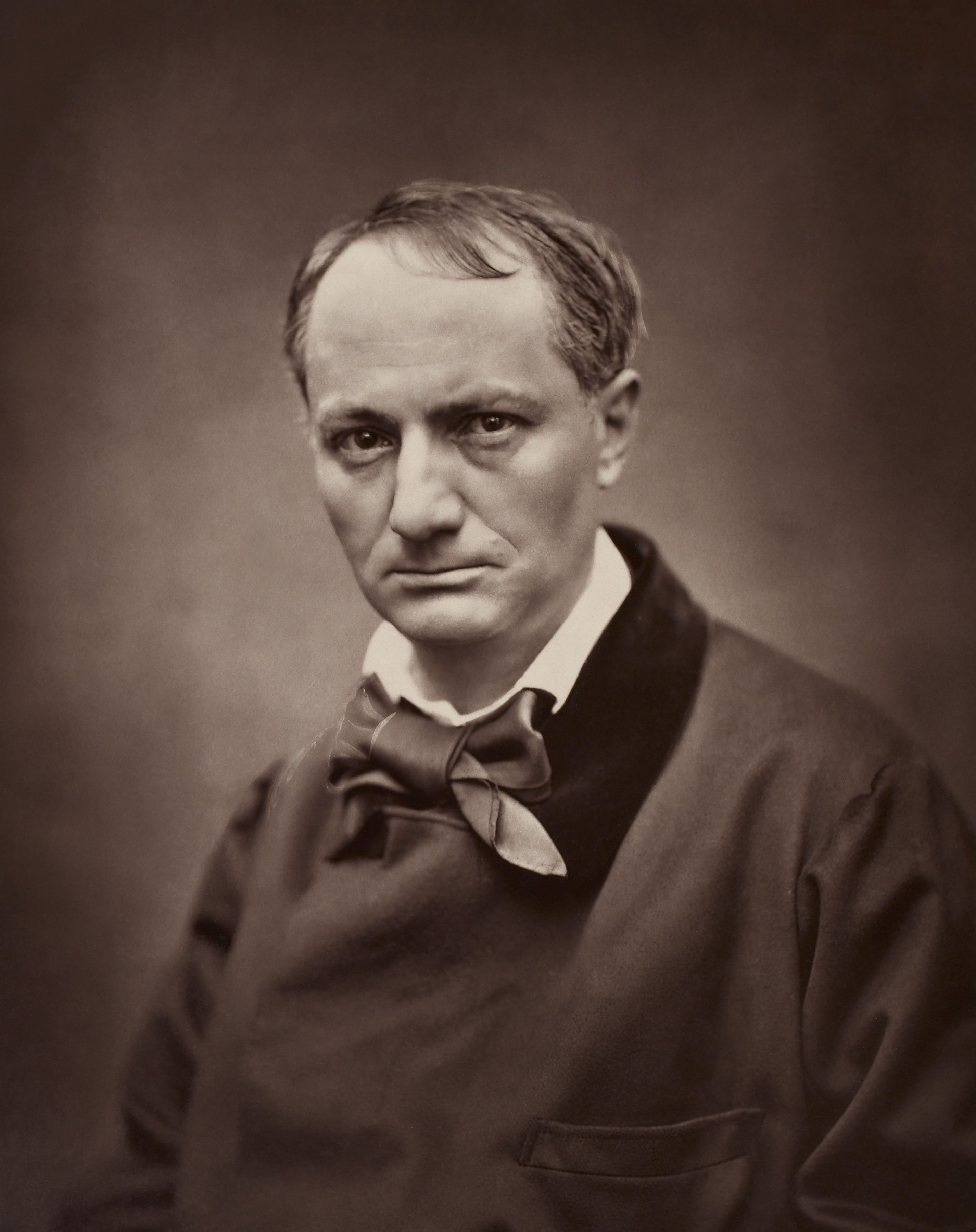
| Charles Baudelaire Étienne Carjat, Public domain, via Wikimedia Commons |
The city of Paris trembles beneath a veil of smoke and fog, its gas lamps flickering like tired eyes half-open against the night. Carriages rattle over wet cobblestones, and the Seine shimmers under a sky aching with gray.
In an attic room, narrow and cold, a poet leans over a candle, pen hovering above the page. His face is sharp with sleepless thought, shadows deepening his cheekbones.
His name is Charles Baudelaire, and he is ready to wrestle beauty out of corruption, light out of darkness, paradise out of despair.
The book does not move in a straight line; it spirals, descends, ascends, and burns. It is not a story with a beginning and end, but a journey through human experience, a pilgrimage through sin, ecstasy, and ruin. Yet it unfolds like a narrative, guided by one wandering soul — the Poet — who insists on confronting every contradiction within himself and the world.
He seeks meaning in a universe that feels like an abandoned cathedral where only echoes answer prayers.
He whispers to himself, a murmur stained with longing:
“Always to love what flees, and always to pursue what flies.”
|
| Charles Baudelaire Étienne Carjat, Public domain, via Wikimedia Commons |
Spleen and Ideal: The Wings and the Chains
The journey begins with struggle. The Poet awakens not to dawn but to suffocation — a feeling Baudelaire names Spleen. The very air is thick, heavy as lead.
He gazes out at the sky but sees only a lid of darkness pressing downward like an iron coffin. Time drips slowly, the hours crawling like wounded animals.
“I am like the king of a rainy country, rich but powerless, young and yet very old.”
His soul flutters like a trapped bird, trying to break free. When inspiration comes, it strikes like lightning — the dream of Ideal, the desperate belief in beauty, art, and transcendence. In those fierce moments the poet imagines himself soaring, wings beating against the sun, like the albatross captured on a ship’s deck:
“The Poet is like that prince of the clouds who haunts the storm and laughs at the archer.”
But reality drags him downward. Mockery, misunderstanding, and the mud of daily life crush him. The albatross — once majestic — becomes ridiculous, wings dragging uselessly on the planks. In the clash between dream and existence, man is both exalted and broken.
The Poisoned Fruit of Beauty
The Poet seeks salvation in Beauty, in sensuality, in women whose presence electrifies the senses. Their faces glow like stained glass, their perfume floats like incense, their voices tremble with the possibility of release.
But beauty does not heal; it intoxicates.
There is Jeanne Duval, fierce and volcanic, whose limbs move like molten gold. When she enters, the room seems to fill with a lush, tropical heat. The Poet-worshipper collapses before her radiance, caught between adoration and destruction. He knows her power; he feels the wound opening in his chest, but still he falls.
“You gave me your mud and I turned it into gold.”
Her love burns, and the poet becomes both priest and victim. Desire is a religion with altars made of flesh and blood, and the sacrifice is always himself.
And then there are other women — pale, mysterious, unreachable — spirits of marble and moonlight. They appear in dreams, in midnight silences, in cemeteries where flowers fade beneath the weight of time. He sees in their eyes the terror of mortality and the light of heaven, intertwined.
Wine: The Temporary Escape
When love fails, he turns to wine, lifting a glass that reflects lamplight like liquid rubies. The world softens around him, the weight inside loosens, and life becomes briefly bearable. His body warms; laughter spills; sorrow recedes like a tide. He whispers to the bottle like an old confidant:
“Wine lights up the eyes of the people.”
For a moment, the Poet believes he has defeated pain. He walks through the streets imagining brotherhood with the workers, the drunkards, the exiled, the fallen. Wine grants wings, but they are only made of paper. They dissolve with morning light.
The Poet wakes with his mouth dry, his soul colder than before. The city rattles back to life, indifferent to his suffering. The reprieve is gone; the abyss gapes open once more.
Paris, the Suffering Queen
And still Paris surrounds him — beautiful and diseased. Fog curls through alleys where children starve under the gold balconies of the wealthy. The streets stink of garbage and perfume, of sweat and rotting flowers. In this city, Baudelaire sees modernity taking shape, monstrous and magnificent.
He watches workers marching with heavy boots, factory smoke filling the sky like industrial prayer. He looks at beggars, prostitutes, thieves, soldiers, and the wealthy who pass them without looking. The city crushes souls beneath its iron wheels.
“To the city of my birth, where even the filth is gilded.”
He cannot escape it; it is part of his blood.
Evil, Sin, and the Seduction of the Abyss
The Poet turns inward now, toward the dark corners of the human heart where vice sits like a spider spinning silk. He does not preach morality; he unfolds experience. Lust, cruelty, jealousy, the hunger for power — each becomes a mirror in which he confronts himself.
In poems like “The Vampire” and “The Irremediable,” he depicts figures who drain the soul or ensnare it forever, symbols of inner demons that cannot be exorcised. He writes of pleasure tinged with horror, beauty spoiled by decay, the fascination of falling. The abyss draws him, not despite the terror, but because of it.
He whispers into the void:
“I have felt the wind of the wing of madness pass.”
Revolt: The Cry Against Heaven
Feeling cornered by suffering, the Poet attempts rebellion against God Himself. He questions divine silence. He looks at a world twisted by injustice and demands answers that never come. In “The Litanies of Satan,” he invokes the ultimate symbol of rebellion, not from devotion but from defiance.
“O Satan, take pity on my long misery!”
It is the cry of a man abandoned by light, trying to forge meaning in darkness. The church hears blasphemy; the poet hears the truth of anguish. This revolt reveals not arrogance, but desperation — the last effort to be heard by a silent heaven.
Death: The Final Doorway
At last the journey approaches its end. Death stands not as terror, but as release. The Poet looks upon it with curiosity, even tenderness. In “The Voyage,” the last great poem of the collection, death becomes a ship prepared to carry him toward the only unknown left to explore.
He stands at the harbor, watching waves strike stone. The wind rises. The water swells. The horizon opens like a wound of light.
“O Death, old captain, it is time! Let us raise anchor!”
There is no triumphant salvation, no perfect conclusion — but there is peace, a quiet surrender. After a life warring against despair, the Poet steps forward, ready to shed the weight of existence.
The book closes, but the echo remains.
The Meaning of The Flowers of Evil
Baudelaire’s masterpiece offers not answers, but brutal honesty. It insists that beauty is born of decay, that light grows only in shadow, that human souls rise and collapse endlessly. It captures:
-
The crisis of modern identity
-
The brutality of urban life
-
The impossibility of purity
-
The double nature of love
-
The eternal war between heaven and earth
-
The urge to transcend human limits
The Poet becomes every person who has struggled in darkness and still reached out for light.

